
CERT provides specialist product legislation and technical support across food, supplements, and all categories of household products. The only exclusion is medicinal products. You are welcome to explore our website to see how we can support your business—or better still, give us a call or send us an email.
Below is a short overview of Toy Safety Regulations and how CERT can assist:
Toy safety requirements across Europe remain among the strictest worldwide. Under the new EU Toy Safety Regulation (TSR), any product “designed or intended for use in play by children under 14 years of age”—whether or not exclusively—continues to be classed as a ‘toy’. The classification remains central to determining whether a product falls under the new regulatory scope.
In 2025, the European Union repealed the former Toy Safety Directive 2009/48/EC and adopted the new Toy Safety Regulation (TSR). This regulation introduces significantly strengthened provisions and modernises toy safety legislation to address new market realities. Major changes include:
- Stricter bans and lower limits for harmful substances, such as endocrine disruptors, allergenic fragrances, PFAS (“forever chemicals”), and the most hazardous bisphenols, with enhanced chemical risk management now at the heart of market approval.
- Mandatory Digital Product Passports (DPPs) for all toys sold in the EU, giving market authorities and consumers digital access to compliance documentation and traceability via QR codes.
- Expanded pre-market safety assessments on every toy, requiring evaluation of chemical, physical, mechanical, electrical, flammability, hygiene, and digital risks—including those linked to the use of connected or “smart” toys.
- Updated and new EN 71 harmonised safety standards, including new or revised parts (such as EN 71-2:2020+A1:2025 for flammability; EN 71-3:2019+A2:2024 for element migration; EN 71-15/16/17:2025 for chemical risks). These will be adopted through 2025 and beyond, reinforcing laboratory testing requirements and reflecting developments in scientific understanding.
Additional requirements focus on:
- Tougher oversight of online, imported, and cross-border toy sales, with full alignment to the General Product Safety Regulation 2023/988.
- Clearer roles and heightened obligations for economic operators (manufacturers, importers, distributors, online platforms).
- A strengthened approach to market surveillance and enforcement throughout the EU.
As compliance becomes more demanding, CERT provides practical guidance, expert label validation, horizon scanning for regulatory updates, and complete technical support to ensure toys placed on the EU market are fully compliant—minimising business risk and supporting overall product safety.
Overview of the obligations of:
Manufacturer
- Design and make toys to meet all safety requirements.
- Prepare and keep technical documentation and a safety assessment for 10 years.
- Issue and keep a Declaration of Conformity for 10 years.
- Mark toys with CE (or UKCA) marking and an identification number.
- Ensure every batch is safe and compliant.
- Put manufacturer name and address on the toy or packaging.
- Provide instructions and safety warnings in the correct language(s).
- Add warnings where needed.
- Fix or recall unsafe toys and inform authorities if there is a risk.
- Provide compliance and safety information to authorities if asked.
- Test and investigate toys that may pose a risk; keep complaint and recall records.
- Ensure safety during storage and transport.
- Know and identify other economic operators in your supply chain.
Importer
- Place only compliant, properly assessed toys on the market.
- Check that manufacturer conformity, documentation, and markings are in place.
- Keep the Declaration of Conformity and help authorities as required.
- Add own name and address; ensure all required documents are present.
- Ensure information and warnings are in the correct language(s).
- Investigate, fix, or recall unsafe toys and inform authorities if there is a risk.
- Test if risks are suspected; keep records of complaints.
- Ensure safety during storage and transport.
- Know other supply chain operators.
Distributor/Retailer
- Act with due care and know legal obligations.
- Confirm toys have conformity markings, manufacturer/importer contact details.
- Check instructions and safety information are in the correct language(s).
- Take action and inform authorities in case of non-compliance or safety risks.
- Provide information to authorities and notify other supply chain actors of safety concerns.
- Ensure compliance during storage and transport.
- Know the supply chain contacts.
Support
Whatever stage of the product development you are involved in, CERT can provide support with:
- Product Risk assessments
- Testing requirements
- Labelling compliance
- Specification and Artwork reviews
- Safety Assessment reviews
- Certification and Declaration requirements.
Which is the correct symbol to use and when?
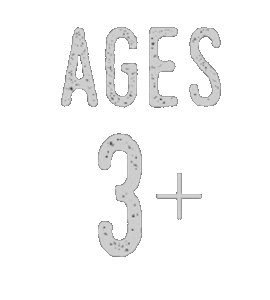
Age 3+ (or appropriate age) is guidance for consumers and is not associated with a specific warning.
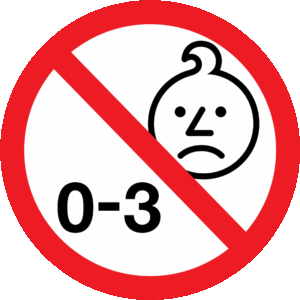
The ‘0-3’ symbol in the red crossed circle, is used to indicate that there is a warning that is age related e.g. ‘{symbol} – Choking hazard’ or the full text version:
‘Warning! Not suitable for children under 36 months. Choking hazard.’
CERT offers practical guidance on ‘grey area’ scenarios under the EU Toy Safety Regulation, where risk assessment is crucial. For example, while standard EN 71 testing ensures materials used in a teddy bear do not pose a suffocation/choking risk, an unusually large teddy bear (the size of a supermarket trolley) could introduce physical hazards—like suffocation/choking—that must be addressed through additional warnings and controls. Such risks may not be directly highlighted in the harmonised safety standards or testing guidance, but are mandatory under the regulation’s expanded safety assessment for foreseeable use and are managed via comprehensive risk assessment, including the use of General Product Safety Regulation 2023/988 and the Toy Safety Regulation (TSR).
Toys cover a wide spectrum—from basic puzzles to complex electronic and chemical-emitting devices. Modern compliance requires that risk management now considers all relevant regulations, including the Toy Safety Regulation, Low Voltage Directive for electrical toys, and REACH for chemicals. The latest rules introduce stronger chemical bans (including PFAS and bisphenols) and demand extensive risk evaluation for all hazards—physical, chemical, digital, and mechanical—related to a toy’s intended and foreseeable use.
The essential safety requirements under the new EU Toy Safety Regulation (TSR, replacing Directive 2009/48/EC) are broader and stricter than before, with a strong emphasis on chemical risks, digital traceability, and safeguarding all hazards in children’s toys.
Essential Safety Requirements
The essential safety requirements under the EU Toy Safety Regulation ensure toys are safe for children by addressing all potential hazards and improving traceability, enforcement, and chemical safety. Below are all the core requirements as set by the regulation:
General Safety Requirements
- Toys and their materials must not endanger the health or safety of users or third parties during normal and foreseeable use, bearing in mind children’s behaviour.
- The developmental abilities and vulnerabilities of children, including age-specific risks, must always be considered in design and risk assessment.
Particular Safety Requirements
- Chemical Safety
- Physical and Mechanical Properties
- Flammability
- Electrical Properties
- Hygiene
- Radioactivity
- Digital Risks: Any digital functionality (e.g., “smart” toys) must not pose mental health, privacy, or security risks to children.
Product Information and Traceability
- Warnings and Instructions: All appropriate warnings and safety instructions must be included in languages understood in the target EU market.
- Digital Product Passport (DPP): Every toy must have a DPP with digital access to full compliance and traceability information (e.g., safety documentation, warnings, QR code).
- Identification: Each toy must be identifiable (type, batch, serial/model number) and carry the name and contact of the responsible EU economic operator.
Once a product meets all essential safety requirements under the EU Toy Safety Regulation, it can display the CE mark (for EU/EEA) or the UKCA mark (for the UK market). This mark confirms the toy complies with all safety, conformity, and documentation obligations—including those required for traceability and the new Digital Product Passport (DPP) system.
Both marks demonstrate that the toy has passed all necessary conformity assessment procedures, meets all applicable harmonised standards, and is safe for sale in those markets. For toys sold in the EU, the CE mark must be clearly visible, legible, and indelible on the toy, its packaging, or accompanying documents—and is now linked to the toy’s Digital Product Passport (DPP), which holds evidence of compliance. The DPP system modernises traceability and compliance accessibility for both authorities and consumers.
Technical Documentation
Under the EU Toy Safety Regulation (TSR), technical documentation for toys must be comprehensive and digital. It must prove the toy’s compliance with all applicable requirements and support the CE/UKCA marking.
Technical Documentation must include:
- General Description of the toy (design, function, intended age group).
- Detailed Drawings and Photos showing construction, components, and materials.
- List of Materials and Parts.
- Full Safety Assessment covering all foreseeable hazards—chemical, physical/mechanical, flammability, electrical, hygiene, and digital risks. This must describe the measures taken to mitigate every relevant risk.
- Test Reports and conformity assessments (e.g. EN 71, EN 62115 for electrical toys), along with names and addresses of any involved notified bodies.
- Copies of Instructions and Warnings in the languages required by each EU market.
- Digital Product Passport (DPP): All the information above must now be accessible digitally (e.g. by QR code) as part of the DPP, which replaces the traditional paper-based Declaration of Conformity for toys.
- Traceability Information: Identification of the manufacturer, EU economic operator, and (if relevant) supply chain operators; batch, model, or serial number data.
- Records of Corrective Actions, Complaints, and Recalls if any such incidents have occurred.
This documentation must be kept for at least 10 years after the toy is placed on the EU market and must be made available to national authorities upon request.
Declaration of Conformity
Under the new EU Toy Safety Regulation, the Declaration of Conformity (DoC) plays a crucial role in demonstrating toy compliance. For the EU, the DoC is now incorporated into the toy’s Digital Product Passport (DPP), providing digital access to all relevant compliance information.
EU/UK Declaration of Conformity
- Content: The DoC must identify the manufacturer, describe the toy (including reference to model or batch), and declare that it meets all relevant legal requirements and harmonised standards.
- Digital Product Passport: For the EU, the DPP replaces the paper-based declaration, ensuring conformity information (including traceability and safety documentation) is accessible via a QR code or similar digital method.
- Retention: The DoC must be created and kept for at least 10 years after the toy is placed on the market (both EU and UK).
- Affirmation of Compliance: It must clearly state compliance with the essential safety requirements of the new Toy Safety Regulation (TSR) and any other applicable EU/UK law.
- Accessibility: The digital approach allows national authorities and consumers to readily access the declaration and supporting documentation, improving transparency and enforcement.
For the UK, the process remains similar—manufacturers must draw up the UK Declaration of Conformity and affix the UKCA mark if the toy is for the UK market. The EU and UK versions are largely aligned but use region-specific references (CE or UKCA, and the relevant regulations). Under the Toy Safety Regulation, the Declaration of Conformity (DoC) is integrated into the Digital Product Passport (DPP) for toys, ensuring digital access to all relevant compliance information. The DoC must state the manufacturer’s identity, describe the toy (model, batch, or serial number), and affirm that the toy conforms with all essential requirements and applicable harmonised standards of the regulation. It must be maintained for at least 10 years after placing the toy on the market and made accessible to authorities or consumers via the DPP, usually through a QR code or similar digital method.
This overview provides a general summary only and does not cover specialist topics which demand a more granular approach. These intricate areas are precisely where CERT’s expertise adds value, offering bespoke support and practical solutions aligned with your development timetable.
For tailored compliance strategies or answers to complex regulatory questions, please contact CERT. CERT takes pride in delivering solutions matched to the unique needs of your business, ensuring that every requirement is covered and every challenge addressed.
Let’s see how we can get your product up and running with the right service or specialist support. Please select ‘Would you like to discuss your project?‘ so we can connect you with the most suitable regulatory expert in our team and make the most of our first call.
Clear Effective Responses to Technical challenges