
Clearly Explained Recycling Terminology
What are the new labelling requirements in Spain and what do I need to do?
The mandatory recycling labelling requirements for packaging in Spain under Royal Decree 1055/2022 came into effect on January 1, 2025. This regulation applies to household packaging (e.g., bottles, cans, cartons) and requires clear labelling indicating the appropriate recycling container (yellow for plastics/metal/composites, blue for paper/cardboard, etc.)
Contents
What are the obligations?
Does the requirement apply to all packaging?
Description of the Pictograms
Yellow Bin
Blue Container
Brown Bin
Green Container
Example Layout
Graphics support from procircular.es
What do I need to do?
What are the recommended additions to the label?
The Material Alpha Numeric Code – Decision 97/129/EC
Packaging Component Identification
Are there further specifications?
Why did the Spain see a reason for a change?
What happens if I don’t label my packaging accordingly?
What are the obligations?
Market introducers (producers) focus on clear disposal instructions and material transparency for packaging placed on the Spanish market after 1 January 2025.
Key requirements include:
Mandatory Labelling Requirements
- Disposal Container Symbols: Packaging must display visible, legible symbols indicating the correct recycling container (e.g., yellow for plastics/metal, blue for paper/cardboard).
- Reusable Packaging: Must include reusability indicators and the Deposit, Return, and Refund System (DRS) symbol if applicable.
- DRS Implementation: Mandatory for reusable packaging and certain single-use plastic bottles (e.g., ≤3L beverages) if recycling targets are unmet.
- Compostable Packaging: Requires a label stating “do not leave in the environment” / “No abandonar en el entorno” to prevent littering. The term “entorno” (environment) is used instead of “medio ambiente” (environment) in this specific regulatory context.
- Multi-component Packaging: It is mandatory to identify packaging components when stating recycling instructions for multi-material packaging.
- Material Codes: Still a voluntary option but recommended if you are identifying multi-material packaging, as per use in Italian recycling to assist in identifying packaging materials (e.g., resin identification codes) to indicate material composition.
Technical Specifications:
- Symbol Size: Minimum 8mm (ideally 10mm) for legibility.
- Durability: Symbols must remain intact even after packaging is opened.
- Multi-material Packaging: Each component must specify its respective disposal container.
Symbol formats:
- The symbols should be clearly visible on the packaging.
- The symbols should not be obscured by other elements of the design or packaging.
- The symbols don’t have to be in colour (but colour symbols are preferred) – they can be in black and white, provided you indicate in words on the label that they should be ‘yellow’, ‘green’, ‘blue’ or ‘brown’.
Exemptions: Packaging placed on the market before 1 January 2025 remains exempt from these labelling requirements i.e. already in Spain. If it has not passed through Spanish Customs, then it is not on the market.
Does the requirement apply to all packaging?
The new environmental labelling requirements apply to primary and secondary packaging sent to consumers.
The only exemptions are:
- Medical Packaging: Primary packaging for medicines and baby food.
- Dangerous Goods: Packaging for hazardous materials
- Compostable Plastics: Exempt from certain labelling requirements but must include warnings like “do not leave in the environment”.
- Special Cases: Raw materials, very light plastic bags (exempt until future composability mandates), and specific industrial batteries.
Description of the Pictograms
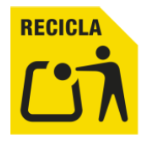
Yellow Bin: Plastic, Metal, and Composite Packaging
This symbol is used on packaging made of plastic, metal, and composites that must be collected in the yellow recycling container. Examples:
- Plastic packaging: beverages, shampoo, cleaning agents, shower gel, shopping bags
- Metal packaging: soft drink cans, tin cans, deodorants
- Composite packaging: juice, milk, milkshakes
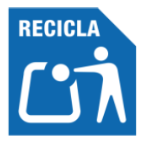
Blue Container: Paper and Cardboard Packaging
This symbol is used on paper and cardboard packaging that must be collected in the blue recycling container. Examples:
- Paper packaging: cookie boxes, cereal cartons, shoe boxes, frozen food packaging, paper bags
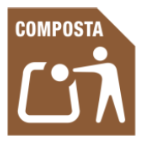
Brown Bin: Compostable Packaging
This symbol is used on compostable packaging that must be collected in the brown recycling container. Packaging is considered compostable if it meets the UNE EN 13432:2001 standard and can decompose in industrial facilities. Examples:
- Compostable packaging: materials that can decompose under certain conditions and be used as fertiliser.
Green Container: Glass
This symbol is used on glass packaging that must be collected in the green recycling container. Examples:
- Glass packaging: any glass bottle (for wine, spirits) or jars and containers (for cosmetics, perfume, jam, preserves)
CMYK: 0/10/100/0
Pantone: P 109C
100/50/0/0
P 300C
21/60/79/30
100/0/100/0
P 300C
See below, first row = without the expression “Recycle” for smaller available labelling space.
Second row = with “Recycle” for larger available labelling space.
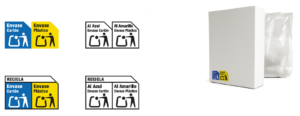
The above sample is for a Cereal Box with contents in a plastic bag – the Cardboard Box goes into the blue bin, the plastic bag into the yellow bin.
Graphics support from procircular.es
Procircular.es is the packaging supporting arm for Spain:
- Variations of logo layout (In Spanish)
- Logos in vector images (high resolution that downloads as a .zip file)
What do I need to do?
- Confirm if you are using packaging in Spain. This refers to primary (product) packaging and secondary (shipping) packaging that you use to send items to customers in Spain. Please note that this obligation only refers to packaging, not to the products itself.
- If using multi-material packaging and voluntarily specifying the material used, check which alphanumeric code for identifying your packaging according to Decision 97/129/EC.
- Make sure you affix the combination of the alphanumeric code, component identification and instructions for disposal to your primary and secondary packaging.
What are the recommended additions to the label?
The Spanish packaging law recommends adding further information to the label though it isn’t mandatory. This can include:
The Material Alpha Numeric Code – Decision 97/129/EC – VOLUNTARY
A common misconception is that the triangle with straight arrows is a Möbius Loop, indicating that is recyclable. This is not a recyclable symbol, as it is part of the alphanumeric code symbol according to Decision 97/129/EC which indicates the material type. The Möbius Loop is a similar design but instead of straight arrows, the arrows are turned in:
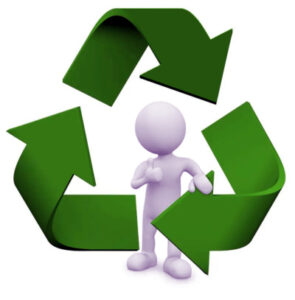 This symbol is royalty free and internationally recognised to indicate the material is recyclable. If placed on product labelling, it is recommended to indicate the component it is referring to e.g., box / tag / sleeve / wrapper etc so it is clear.
For material identification purposes, some common examples are:
Symbol Code Description Examples
 1 PET(E)
Polyethylene terephthalate
Polyester fibres, soft drink bottles.

2 PEHD or HDPE
High-density polyethylene
Plastic bottles, plastic bags, trash cans, imitation wood.

3 PVC
Polyvinyl chloride
Bottles for chemicals.

4 PELD or LDPE
Low-density polyethylene
Plastic bags, buckets, soap dispenser bottles, plastic tubes.
 5 PP
5 PP
Polypropylene
Take-away beverage cups.
 6 PS Polystyrene
Beverage/food coolers, beer cups, wine and champagne cups, take-away food containers, Styrofoam

7 O (OTHER)
All other plastics
Polycarbonate (PC), polyamide (PA), styrene acrylonitrile (SAN), acrylic plastics/polyacrylonitrile (PAN), bioplastics

20 C PAP (PCB)
Cardboard Boxes and corrugated paper packaging.

21 PAP
Other paper Mixed paper magazines, mail

22 PAP
Wax Paper (single sided) Fast food sandwich wrappers, meat packing, gum wrappers, some drink boxes.
Packaging Component Identification
Clearly identifying the types of packaging in multi-component packaging is required to help the end user to separate and dispose of individual parts. Whether this is done by using a graphic or a short text is optional. If written, the text must be in Spanish.
Are there further specifications?
Some widely-applicable specifications include:
- If packaging consists of several materials but the secondary material, i.e. the second-most used material in the packaging, is less than 5% of the total weight, they are classified as single-material packaging. They are then labelled according to the predominant material by weight. The 5% rule is relevant when using printing ink or glue, for example.
- A packaging system that provides for a main body (e.g. out of cardboard) and other additional components (e.g. out of plastics) that cannot be manually separated must include the identification code of the material of the main body and the instructions for disposal for the material of the main body.
- It is mandatory to include labelling of all components that can be separated by hand. If this is not possible, then either on the main part of the packaging or on a separate label; otherwise on another component that makes the information easily visible to the consumer.
- If, due to lack of space or other technical reasons, it is not possible to place the label on the packaging, it is permissible to place the contents of the label on a separate medium (e.g. package insert) or via digital channels (e.g. QR code).
Why did Spain see a reason for a change?
High-quality recycling can only succeed if the materials sent to be recycled are well-sorted to begin with. The end-consumer must first be able to put the specific waste material in the correct recycling path. The sorting instructions are intended to help and educate the end-consumer. Spain wants to increase its recycling rate and better support the circular economy. It is in debate whether this action from Spain constitutes a barrier to trade, but has not been over-ruled by the European Commission yet and so is an enforceable law.
What happens if I don’t label my packaging accordingly?
Under Spain’s Royal Decree 1055/2022, companies failing to comply with mandatory recycling marking requirements face financial, legal, and operational consequences: Financial Penalties:
- Fines up to €600,000: Non-compliant companies can be fined under Article 109 of the decree, with penalties scaled based on the severity of violations.
- Enforcement undertakings: Companies may pay donations to environmental projects instead of facing prosecution, though this is less common than direct fines.
Legal and Regulatory Actions:
- Prosecution: Repeated or egregious violations may lead to criminal charges, particularly for falsifying data or systemic non-compliance.
- Product Bans: Packaging without proper labelling (e.g., disposal symbols, material codes) cannot be placed on the Spanish market after 1 January 2025.
- Prohibited Claims: Using terms like “environmentally friendly” or misleading symbols (e.g., Green Dot) risks additional fines.
Some widely-applicable specifications include:
- If packaging consists of several materials but the secondary material, i.e. the second-most used material in the packaging, is less than 5% of the total weight, they are classified as single-material packaging. They are then labelled according to the predominant material by weight. The 5% rule is relevant when using printing ink or glue, for example.
- A packaging system that provides for a main body (e.g. out of cardboard) and other additional components (e.g. out of plastics) that cannot be manually separated must include the identification code of the material of the main body and the instructions for disposal for the material of the main body.
- It is mandatory to include labelling of all components that can be separated by hand. If this is not possible, then either on the main part of the packaging or on a separate label; otherwise on another component that makes the information easily visible to the consumer.
- If, due to lack of space or other technical reasons, it is not possible to place the label on the packaging, it is permissible to place the contents of the label on a separate medium (e.g. package insert) or via digital channels (e.g. QR code).
Note: This information is provided as general guidance and does not constitute legal advice. If you require more detailed support, please either get in contact with the market authority responsible for packaging sustainability or please feel free to get in contact with the CERT regulatory team.
Services and Product Areas CERT support
Do you want to discuss a product?
Let’s see if we can get your product up and running with a service or specific product support. This link will help ensure you get matched with the best regulatory professional in the team for your enquiry and help us both make the most of our first call.
Clear Effective Responses to Technical challenges