

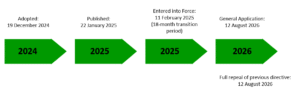
The EU Packaging and Packaging Waste Regulation (PPWR, Regulation 2025/40) introduces harmonised rules for all packaging placed on the EU market, affecting both manufacturers and importers. This new regulation came into force in February 2025 and applies from August 2026 and covers design, recyclability, Extended Producer Responsibility (EPR), documentation, and labelling, regardless of where it is produced or imported from, with comprehensive and harmonised rules covering the entire packaging lifecycle—from design to waste handling.
EPR and Scope
Manufacturers and importers must participate in EPR schemes, financing the collection, recycling, and return of packaging. EPR obligations apply to primary, secondary, and tertiary packaging—with exemptions only for reusable packaging as defined in the Regulation. Secondary and tertiary packaging are not automatically exempt from EPR fees, unless used in deposit-return or specific circular economy schemes. Micro-enterprises must also comply with local EPR representation rules: a separate authorised representative is required in each Member State where products are first placed on the market, unless the business already has a legal entity there.
Packaging Types:
Primary Packaging (Sales Packaging): Packaging unit for the end user or consumer at the point of purchase.
Secondary Packaging (Grouped/Multi-Packaging): Packaging designed to group a number of sales units, either to facilitate handling, stocking, or to be sold as a multipack.
Tertiary Packaging (Transport Packaging): Packaging designed to facilitate handling and transport, protecting products from damage in transit, but specifically excludes containers used for transport by road, rail, air, or sea.
Design, Recyclability, and Labelling
From 2030, all packaging must be either recyclable or reusable, with plastics required to meet minimum recycled content (30–65% by type). Packaging using formats that cannot reach 70% recyclability (grade C) will be prohibited. Harmonised pictogram labels showing material type and disposal method become mandatory by 2028. If space is limited, digital options such as QR code links are required. Manufacturer contact details and traceability via batch numbers, barcodes, or QR codes support enforcement, with misleading recycling claims expressly prohibited.
Recyclability Grades and Thresholds
Packaging must achieve at least 70% recyclability by weight, classified under the performance grades A (≥95%), B (≥80%), or C (≥70%). Packaging below 70% recyclability (i.e., below grade C) will be prohibited from 2030.The recyclability grade will be calculated based on the portion of packaging material that can be collected, sorted, and reprocessed within current EU industrial recycling systems.
Traceability and Product Passports
From 2028–2029, a digital product passport (linked via QR or similar code) must accompany all packaging, providing details on material composition, recyclability, recycled content, reuse cycles, and any substances of concern. Traceability should be maintained for at least 5–10 years, ensuring authorities can rapidly verify compliance and track packaging throughout its lifecycle.
Documentation and Reporting
Manufacturers and importers must maintain technical documentation and Declarations of Conformity for each packaging type, referencing all applicable EU regulations and harmonised standards. All packaging data, including quantities, materials, recycled content, and reuse figures, must be reported annually to national authorities. Supply chain actors—including distributors and e-commerce platforms—share responsibility to verify packaging compliance prior to market entry; non-compliant packaging must be withheld or recalled.
Declaration of Conformity
- Every packaging type must be accompanied by an EU Declaration of Conformity (DoC). This document must:
- Identify the packaging and its components,
- Contain full manufacturer/importer details,
- Reference relevant articles of the PPWR and any harmonised standards used,
- Demonstrate compliance with requirements such as substances of concern, material reduction, recyclability, labelling, recycled content, and reuse cycles,
- Be signed by the responsible party taking legal responsibility for compliance.
- If packaging is subject to multiple EU regulations (such as food contact plastics), a single merged Declaration must address all applicable legislation.
Supply Chain Responsibility
Importers must verify that packaging they bring in complies with design, recyclability, and labelling requirements before market entry. Non-conforming packaging must be withheld or recalled. Shared responsibility applies to distributors and e-commerce platforms, who must also check compliance.
Application and Exceptions
- Scope: The regulations broadly apply to all companies placing packaging on the market, including micro and small enterprises, with very limited sectoral reliefs.
- Phased Introduction: Main obligations apply from August 2026, with stricter targets and requirements phased in by 2028 and 2030 (e.g., prohibitions, deposit-return systems, minimum recycling content).
- Third-country Imports: Non-EU companies shipping directly to EU consumers must appoint an authorised representative in the EU to be accountable for compliance.
Actions for Businesses
- Audit and document packaging, conformity, and recyclability.
- Join or establish EPR arrangements in every Member State of sale.
- Prepare for strict labelling and digital passport obligations from 2028 onward.
- Maintain all records for 5–10 years and ensure full traceability throughout the supply chain.
- Check phased requirements, country-specific obligations, and upcoming national rules regularly.
Non-compliance risks recalls, financial penalties, and exclusion from the EU market, making robust compliance systems essential for continued market access from 2026 onward.
Let’s see how we can get your product up and running with the right service or specialist support. Please select ‘Would you like to discuss your project?‘ so we can connect you with the most suitable regulatory expert in our team and make the most of our first call.
Clear Effective Responses to Technical challenges