

Toys in the EU & UK
CERT provides specialist regulatory and technical support across all product sectors, including toys. We help businesses navigate complex EU and UK requirements with clarity and confidence.
Interested in tailored support? Register your project interest so we can arrange a complimentary call with the relevant regulatory professional in our team.
In the EU and UK, toys are governed by dedicated regulatory frameworks, including the new EU Toy Safety Regulation and the UK Toys (Safety) Regulations. These regulations are designed to address all key hazards associated with children’s products, covering mechanical and physical safety, flammability, electrical and hygiene risks, chemical restrictions, and strict rules on information, warnings and traceability.
What counts as toys
Under the new EU Toy Safety Regulation (TSR), a toy is any product “designed or intended, whether exclusively or not, for use in play by children under 14 years of age.” This broad definition mirrors the current UK approach (based on Directive 2009/48/EC retained in UK law) and remains central to deciding whether your product falls in scope.
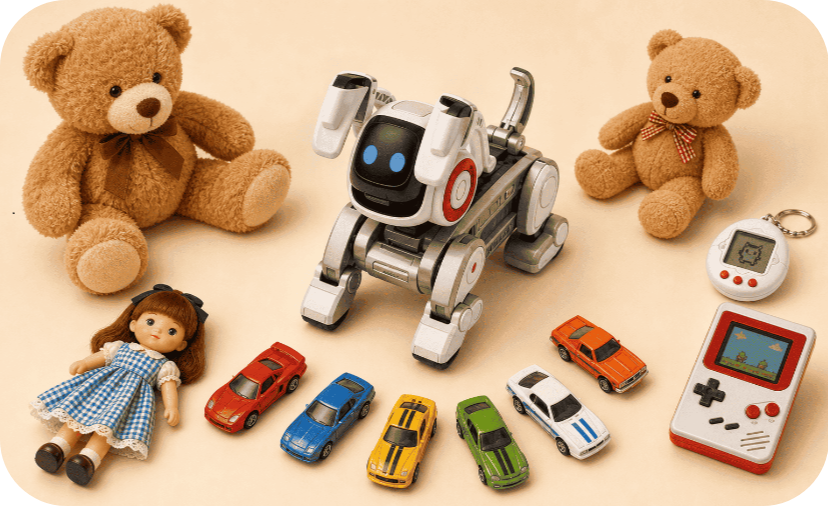
Toys span simple puzzles, plush and traditional items through to complex electronic, connected and chemical-emitting products, so classification must consider intended and foreseeable use, presentation, and how children are likely to interact with the product.
Grey‑area products (e.g. décor with a strong play value) often need a structured risk and use‑scenario assessment to determine whether toy rules apply.
Core obligations include:
Once a product is in scope as a toy, all economic operators in the EU and UK, manufacturers, importers, distributors and retailers, must ensure it meets the essential safety requirements for chemical, physical/mechanical, flammability, electrical, hygiene, radioactivity and (where relevant) digital risks, taking account of children’s age, behaviour and foreseeable misuse.
They must carry out and document safety assessments, maintain technical documentation (and from 1 August 2030, a DPP for EU toys), perform conformity assessment to applicable standards (such as EN 71 and EN 62115), and ensure toys bear the correct CE/UKCA markings, identification codes and contact details, with clear instructions and warnings in the appropriate languages.
Across the supply chain, operators must control production quality, keep records of complaints, non‑conforming products and recalls, ensure toys remain safe during storage and transport, cooperate with authorities, and take prompt corrective action, including withdrawal or recall, whenever safety risks are identified.
Markings and information
Toy labelling in the EU and UK now combines traditional safety information with new digital traceability requirements designed to support enforcement and consumer transparency. The correct use of age indications and warnings is essential to communicate residual risks clearly.
CE/UKCA: Toys sold in the EU/NI must bear the CE mark; toys for Great Britain require CE/UKCA (CE is till accepted indefinitely), visibly, legibly and indelibly on the toy, packaging or accompanying documents. The CE mark in the EU/UK links directly to the toy’s DPP, which holds digital evidence of compliance.
Digital Product Passport (DPP): Under the TSR every toy placed on the EU market will carry a data carrier (typically a QR code) providing access to the DPP, which integrates the Declaration of Conformity, technical information, warnings and traceability data for authorities and consumers (Mandatory from August 2030).
Identification and traceability: Toys must show a type, batch, serial or model number and the name and contact address of the responsible EU/UK economic operator, enabling rapid tracing and corrective action if safety issues arise.
Warnings and symbols:
“Age 3+” (or similar) is consumer guidance and not, by itself, a safety warning or legal restriction.
The “0–3” symbol in the red crossed‑out circle is a safety warning indicating that the toy is not suitable for children under 36 months, and it must be accompanied by an appropriate hazard statement such as “Warning! Not suitable for children under 36 months. Choking hazard.”
Additional warnings and instructions are required for particular categories (e.g. functional, chemical, aquatic, activity toys, and toys for use in water), and must be in the official language(s) of the country where the toy is marketed.